
Revealed: How to craft a first 30 days content strategy that’ll prove you were the right hire.
When people talk about your “first 90 days” as a product marketing leader, the advice is usually framed like a performance.
Be visible.
Ship something.
Prove value.
Look like you know what you’re doing.
But that framing misses the point.
The best moves you can make early in a new role aren’t “proof moves.” They’re infrastructure moves. They’re compounding moves. They’re moves that keep working long after the novelty of your ramp period wears off, and they keep working even as you learn the nuance of your market, your product, and your buyers.
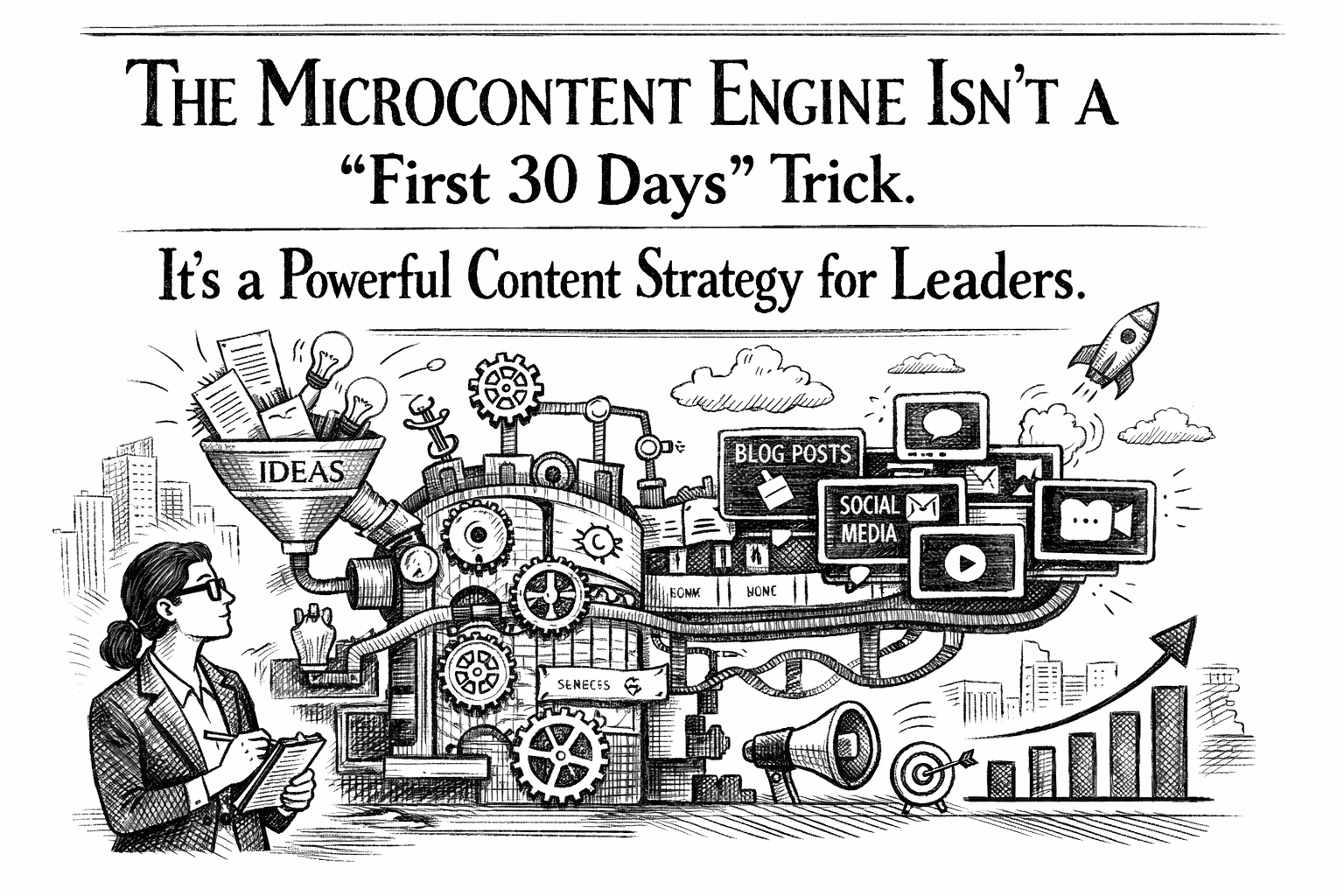
A microcontent engine is one of those moves.
Not because it makes you look competent (though it does).
Because it’s the rare content strategy that:
- works in every environment (growth or contraction)
- aligns with how people actually buy (especially in B2B)
- doesn’t require you to guess your final positioning on day one
- and doesn’t create a pile of content debt you’ll hate later
The real “first 30 days” problem isn’t speed. It’s content debt.
Most newly hired marketing leaders create content that feels useful now, but becomes painful later.
You publish broad, generic messaging because you haven’t learned the sharp edges yet.
You write thought pieces that reflect what you assume matters, not what you’ve confirmed.
You write for the audience you’ve been told the company targets — and trust me, you’ll find through your own research that some of the details they’re so sure of are flat out wrong.
You create assets that aren’t wrong, exactly… they’re just soft. And soft content doesn’t age well.
Then, six months later, you’re staring at your own work thinking:
“I need to redo all of this.”
That’s content debt. It compounds in the worst way. It makes your library feel like clutter instead of leverage.
A microcontent engine solves this because it’s built around extraction, not invention.
It doesn’t ask you to create your final narrative immediately. It asks you to capture what is already true inside your organization and your customer experience so you can get your sea legs while building, and then apply these new tools to new assets once you’ve identified the gaps.
Truth ages better than opinion.
The microcontent engine is a truth-capture system
Here’s the thought leadership point most people miss:
Microcontent is not “repurposing.”
Microcontent is signal processing.
Your organization already has proof:
- what customers praise (and what they complain about)
- what sales reps hear every week
- what onboarding struggles with
- what product managers obsess over
- what support tickets repeat endlessly
That is your market’s real language.
A microcontent engine is how you capture it, clean it up, and redistribute it in formats buyers can actually absorb.
Why it works even before you fully understand the market
New leaders often hesitate because they don’t want to publish something they’ll later regret.
Correct instinct.
But the answer isn’t silence. The answer is choosing content inputs that don’t require you to have perfect positioning yet.
So instead of writing sweeping brand-level narratives, you start with microcontent that is:
- specific
- attributable
- grounded in real customer language
- and focused on buyer jobs-to-be-done
The microcontent engine lets you show up without pretending you already know everything.
Because you’re not publishing “what you think.”
You’re publishing “what we’ve observed,” “what customers told us,” and “what works.”
Audience investment is the hidden math behind great content
Most content fails because it asks for too much trust too soon.
In early stages, buyers will not read your whitepaper. Not because it isn’t valuable but because they haven’t decided you deserve that much attention.
Microcontent matches the moment they’re in:
- small investment
- fast payoff
- low risk
- easy to share internally
Best of all, it’s how internal champions arm themselves without becoming your unpaid intern.
The “no regrets” microcontent formats
If you want content you won’t have to redo later, start here:
1) The Proof Clip
A 15–45 second customer moment: results, relief, or clarity.
2) The Objection Flip
One sentence that names the fear, one sentence that resolves it with specifics.
3) The Before/After Snapshot
Before: messy reality. After: measurable improvement.
4) The “What This Replaces” Post
Spell out what your product eliminates: time sinks, risk, chaos, manual steps.
These formats hold up because they’re anchored in reality, not in your early assumptions.
The microcontent engine plan (built for compounding)
This is the durable version. Not the “new job” version.
Step 1: Choose 3 truth sources
- customer calls (sales, onboarding, QBRs)
- support tickets
- webinar/demos
Step 2: Extract 25 micro assets
- 10 proof moments
- 10 objections
- 5 “how it works in practice” insights
Step 3: Distribute where trust is built
- LinkedIn (for proof + clarity)
- email (for one idea + one CTA)
- sales enablement (for objection handling)
Step 4: Tie each piece to ONE next step
Microcontent isn’t the destination. It’s the ramp.
The real win: you build messaging while you build momentum
The microcontent engine doesn’t just create outputs. It invites your audience to lean in.
Best of all, you’ll soon find yourself noticing patterns:
- the words customers repeat
- the fears they hide behind polite questions
- the objections that are really political constraints
- the “aha” moments that trigger internal forwarding
Over time, those patterns become your positioning.
So the microcontent engine isn’t a substitute for strategy.
It’s how you earn strategy faster without publishing a bunch of content you’ll later want to bury.